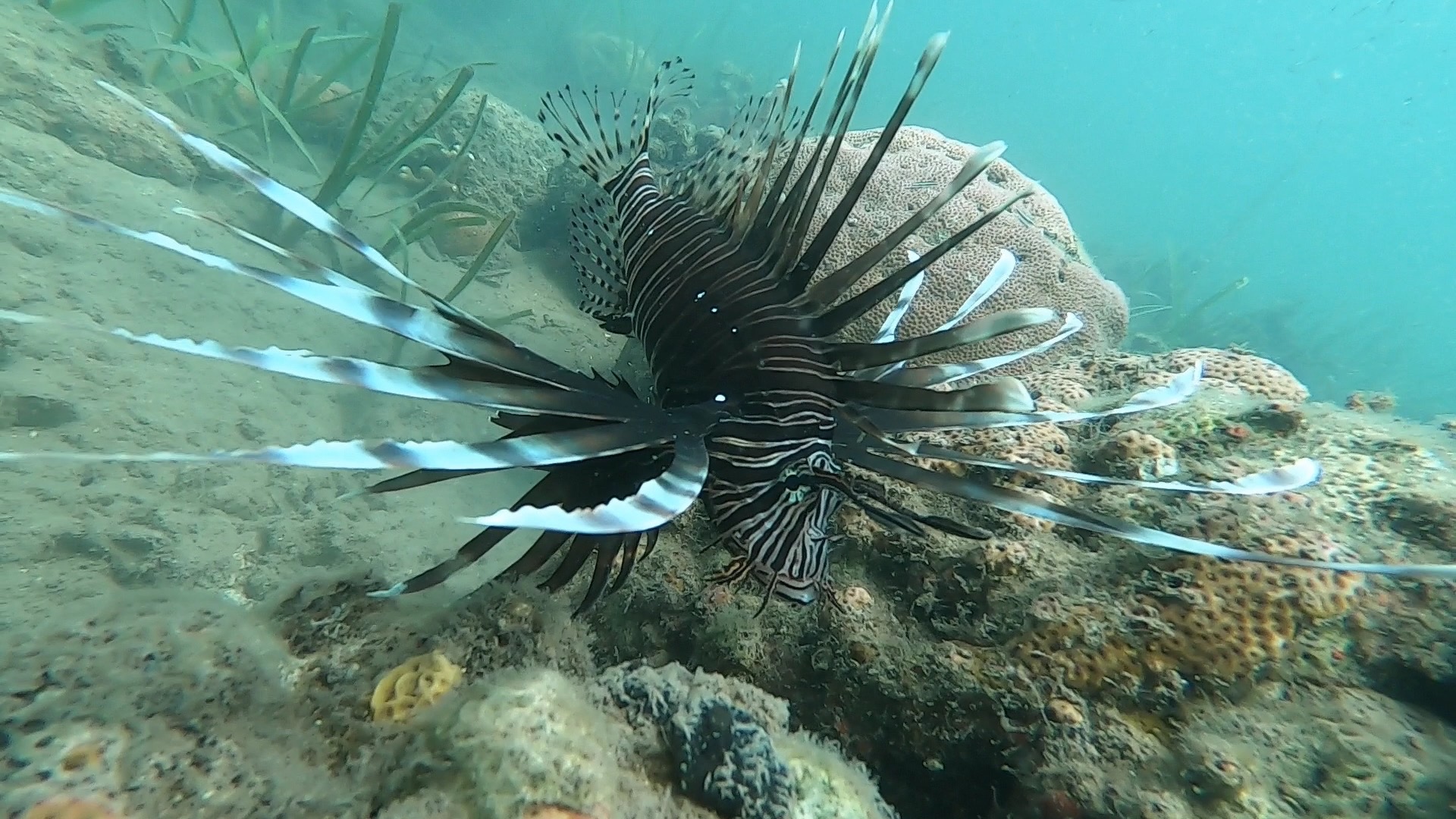
What a heck of a fish, right!?! This impressive bundle of venomous spines and its intricate and beautifully designed entirety is the Indo-Pacific Lionfish and as peaceful as this beauty may seem, she’s a beast that’s hunting out our local, native fish species.

The lionfish is an exotic species to the Caribbean, meaning it doesn’t belong here in Bocas—they are native to the far off Indo-Pacific, yet the species has found its way into the Caribbean Sea and the Greater Atlantic, starting back in the mid ‘80s, most likely as aquarium escapees.
Reef ecosystems are at incredible risk of decimation by this beautiful, exotic predator that preys upon native fish species to despairing amounts. It’s actually a surprisingly unassuming species that floats lazily in place, even within arms reach, should you come across one. They have no fear of humans and with good reason, those spines covered in a mucous venom are terribly painful and can last for days and a real bad case can even cause paralysis.
What is the most worrying is the insanely massive reproduction rate this fish has. The female reaches reproductive maturity in less than a year, lays 50,000 eggs every three days and will do so for the rest of her life (lifespan can be more than a decade). Thus, this opportunistic predator quickly invaded the sensitive coral reefs of the warm water locales of the greater Atlantic Ocean and these native ecosystems were not evolved to defend against this voracious, invasive, venomous species eating away at the biodiversity of Atlantic, Caribbean and Gulf of Mexico reef ecosystems.
Lionfish are skilled predators and are known to eat young parrotfish and baby snappers like popcorn—and it doesn’t stop there—this is a highly generalists species and so whatever they can fit into their mouths, they will rapaciously consume, this even includes young lobster and other marine invertebrates.
And if you’ve put your face in the water or looked down from a dock on a clear day, you’ll see there’s a dearth of fishes in the Bocas del Toro archipelago. They’re there, there are many and they’re diverse and beautiful. In fact, my favorite activity in Bocas is snorkeling so I’m not saying it’s not worth it to take a look yourself, but rather, how the archipelago sensitive reef eecosystems have been impacted over time long before us and our outlook.

Management is what my Ngäbe hermanos, the captains that have fished this archipelago for fifty years agreed is what needs doing. And these are weathered, beautiful, dark-faced, distant eyed men who’ve seen the changes. Humanity has made major changes to this archipelago and these men have seen it over a much longer time than the majority of us. By joining forces we’re trying to get the word out about the lionfish to visitors to the archipelago and amongst those of us living as expats in Panama don’t know about simply because we weren’t born here.
It’s not about blame, it’s about awareness, through education.

The majority of species that the lionfish prey upon are herbivorous. Parrotfish in particular eat various species of algae that grow over top of the corals almost like a green or brown blanket, thus suffocate and killing the coral polyps underneath. As this diversity of native herbivore species are taken out of the ecosystem, entire coral reefs suffer and are smothered to death by unstopped algae growth.
Something found about these fish is that they are even adapted to live in brackish waters, which is concerning for entire other ecosystems, seagrass beds and mangrove forests. Mangroves provide food and shelter as the nursery of our coral reef species and commercially caughty fish out in the greater seas and ocean.
I’ve been told that a great deal of the seafood eaten in Bocas is brought over from the Pacific. We’ve fished ourselves out and now we’re left with lionfish and fuzzy humps that were once thriving coral reefs. I try not to make myself or others feel down or guilty, it’s just unfortunately what it is.
But here’s where the @ByeByeLionfish derby comes in. This is Bocas del Toro’s annual lionfish spearfishing competition between teams of indigenous Ngäbe, teams of local fishermen. And the competition isn’t just for the biggest lion fish but also prizes for the smallest and the most fish caught regardless of size because this is a concerted effort to eradicate this invasive species from the Archipelago in a fun and informative way, as we try to share with the tourists why we have this derby.

Among the fishermen who had been out in their pangas since six in the morning hefted coolers full of lionfish to be counted, weighed and registered. It was among three teams from three different Ngäbe communities (native communities which are speckled throughout the archipelago), each with plenty of helpers including several Ngäbe youth who joined their fathers and uncles for a morning of spearfishing for lionfish to take away a prize at the derby.


And that they did. Coolers were full of the beautiful creatures already gutted and long dead. Everyone crowded around, an array of cultures braced together to determine who gets first, second and third prize. And with the well deserved donations by the community, the fishermen went away with a helpful pocketful, and we did put the word out too that any kind of fishing/snorkel gear anyone might have to offer to the Ngäbe and Afro-Caribbean local fishermen would make a big difference in their lives.

I sat and got to know some of the fishermen, whom I’d only met for the first time right as they came off the boat. While I waited nervously to take the mic and award the prizes, I chatted with fisherman Saavedra Smith and he told me he’s been spearfishing for 50 years throughout the archipelago and off Bird Island.
Now Imagine the changes he’s seen over time, under the surface. Imagine how we come here and spend five years and only then learn just how much of a terrible impact the beautiful lionfish are raining on the reef we think of as “ours” when really it’s nothing like it once was and the only folks who know it are those who’ve seen it. That’s why I’d love to sit down with a boat captain like Saavedra and, audio recorder in hand, tell me the story of his life.
And that’s why I’m excited to get rolling with my work with the kids of Bocas del Toro, training them in eco-guiding because many of these young fishermen can be and are tour guides and there’s no better guide than one who’s ancestry traces deeply into the lands they’re guiding you through, says the gringa guide! If I can help with English species names and a good dose oftropical ecology, I’ve got an eco-guides in the making.
Young Ngäbe and Afro-Caribbeans have wonderful potential and simply need the tools so they can share their motherland with guests like me in a sustainable, eco-mindful and respectful manner with nature. It’s unfortunate but, we need to let them know early about the huge challenges they have ahead of them. With tourism as ~95% of what Bocas del Toro runs upon, the future needs guides and guides that know how to treat these fragile ecosystems so future generations can see what we see.
I’m good at going melancholy but I must say, this is what we’re looking towards. And Bocatoreno youth nor any other have a choice in having to face whatever is next to come in regard to ecosystem services we took for granted and thus are losing. It sounds horrible but all we can do is keep our chin up. And, to me, that means let’s give them the tools to join us in treading lightly on this Planet Earth and how we share it with guests. We need to accept what changes are ahead, grab the wheel, take a moment and appreciate that nature is still everywhere, just that we need to realize and share with others how we’ve left such an imprint in humanity’s moment of existence on this planet and how we need to lessen it quickly.
Discover more from Bocas Biodiversity: Birding & Wildlife Eco tours by @stacebird
Subscribe to get the latest posts sent to your email.
2 responses to “Bocas del Toro’s “Bye Bye Lionfish” Derby”
-
This is really great, Stace! Your struggle to get the word out and to train the indigenous kiddos so that they can learn English and learn to be wonderful nature guides is such a gift to all of us who deeply love our Mother Earth. Thank you!
-
SOOO MUCH information presented in a format so easy to digest. We Appreciate the informative insight and thank ALL the people who participated for their efforts.
You have a way, as evidenced in this article, which makes us feel that we were right there, experiencing the event and meeting the People, Thank You!


Leave a Reply