Let’s work together to raise awareness about what these unending droughts (at this point we’re way past net negative) are doing to our coral reefs, particularly the branching fire coral. I’ve seen it go blanco enough times in my mere 5 years here that I now know of huge swaths that just can’t deal with this hot water anymore. The cooling rains are not happening when they used to arrive like clockwork.
The algae that lives inside of and colors the coral polyps has had it, it disperses leaving the corals white and lacking the essential supplemental food that the algae provide through photosynthesis. The polyps that are the actual corals which build the hard structure you see and live in tiny holes secreting (growing) calcium carbonate, the skeleton that grows supports the polyps.

Many of these polyps you don’t see because they peek out of their tiny starlike holes (such as on the giant star coral, the red –now turning pink as the algae giving that coral its color and photosynthesis sugar supplemental food give up and evacuate to find cooler waters, marine plankton that is barely visible in the water column but always waiting for the cooling rains to return to their own specific species of coral. Giant Star Corals are almost brain coral shaped red corals you see that tend to have create their own coral specific specific hiding places and structure for the fish that rely on these reefs for food and shelter.
In my time guiding guests to the archipelago through coral reef ecosystems, I’ve seen the struggle as we are missing the essential cooling rains that keep our reefs healthy. Again and again they’ve gone blank to the point where there truly is a great loss of our coral reefs happening under the surface. And it’s not always obvious or evident if you don’t know what you’re looking at.

A whole DIFFERENT (as there are a monumental plethora of algal species that exist in our reefs, each different species in it’s own different niche) kind of algae is now covering our branching fire corals and suffocating the weakened polyps that might not be able to sting and keep it from overtaking the entire coral. This tends to be furry and an unappealing brown/gray color. Once those grow over a coral, that coral is dead and never coming back. That’s where the sickening feeling in my stomach happens when I’m snorkeling with guests who know no different.

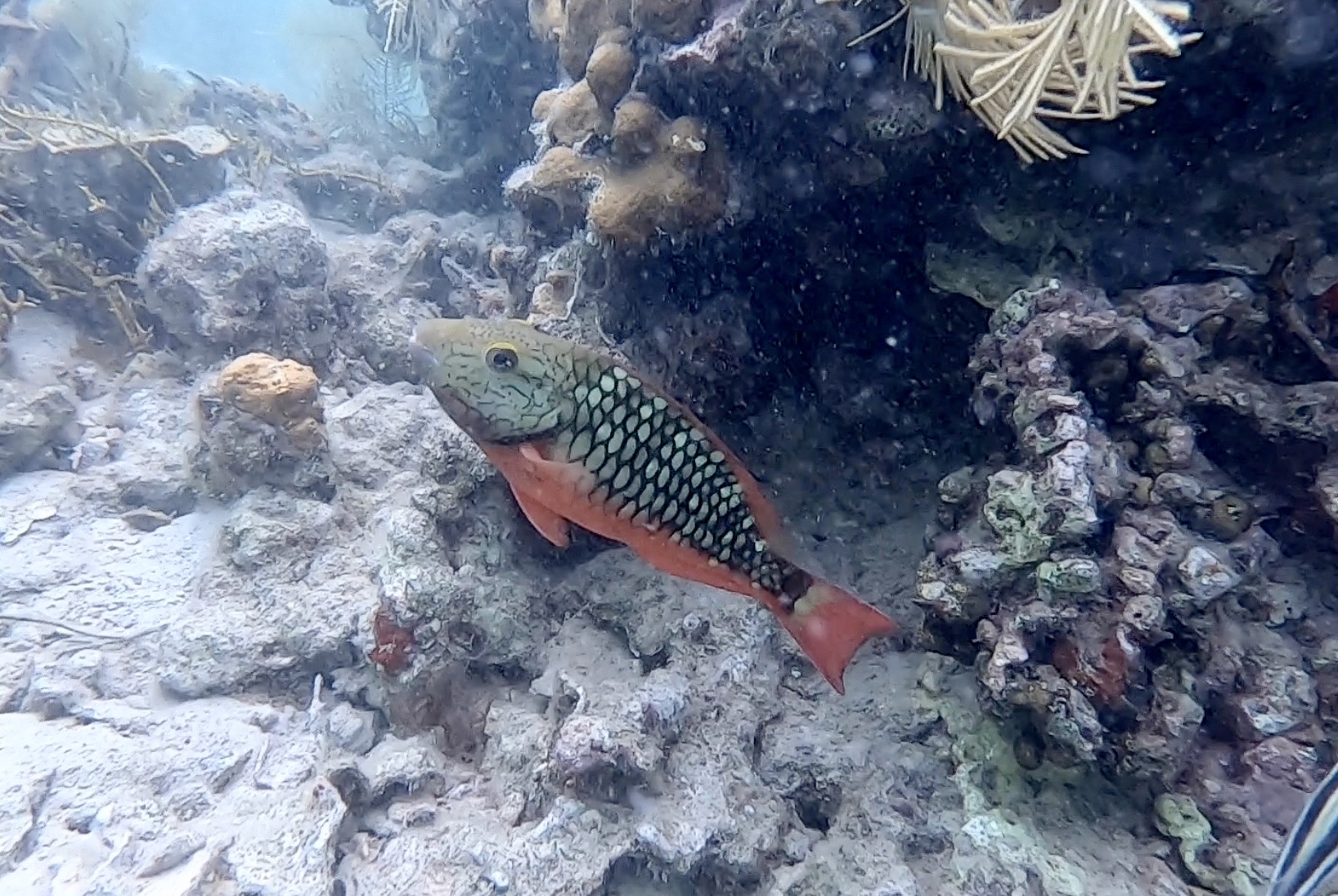
But we must spread the word. Climate change, detrimental human impact, overfishing leading to a dearth of the larger parrotfish that chomp algae off corals (and get bits of corals which they poop out to become the sand beaches we see, thanks to their strong parrot-like beaks). There is no specific human, cultural group or tourist to blame. It’s simply a long history of all human’s lack of awareness and education is what is killing our reefs.
I’m respectfully trying here to start a conversation with all of us who undeniably love our reefs, our rich biodiversity under the superficie. We need to take care to treat it kindly, never let your guests put their feet on the sea floor because even where there’s only seagrass, there are fish eggs, coral embryos, worms, sponges, all trying to simply make it through the day.

Also take care with getting too close to the reef..if you can reach it with your hands from the surface, you’re too shallow. You simply can back off a bit and still be able to take in the majesty that we have left. Keep your legs bent when you raise your head above the surface because even stirring up the silt below one can mean disrupted sealife.
And, finally, best to opt for bare feet over fins as it’s easy to lose track of where they are and I’ve seen enough corals hit by travellers who’d never want to harm the ecosystem yet have unfortunately left it a little less, a little more damaged and sometimes don’t even realize. That’s why we guides need to spread awareness and educate the tourist that come out to this majestic archipelago.
And as I said before, there is no blame on anyone living throughout this archipelago. Simply awareness is key and we can spread it with respect to every culture and guide and boat captain so that we can pass it on to future guests.
Thanks for reading..and watching! This video was created in June 2020. Thanks for joining me on a future of further dedicated education and raised awareness.
Let’s share the awareness, all for our love of Bocas!
~stacebird
#coralreef#caribbeansea#bocasdeltoro#marinelife#reefconservation#bocaslove#caribbeanpanama#coralreefconservation#coralreeflife#ecotours#bocasnature#coralconservation#panamawild#conservation#reefawareness#marinelife#marineconservation#wildpanama#marinebiology#MarinePlankton#coralbleaching#climatechangeawareness
Leave a Reply