The Barn Swallows are on the move! Heading south for the winter, it’s a constant stream of these tiny sprites. One of my favorite birds growing up I’d watch them in astonishing aerial displays as they chatter on and on with each other and catch insects on the wing.

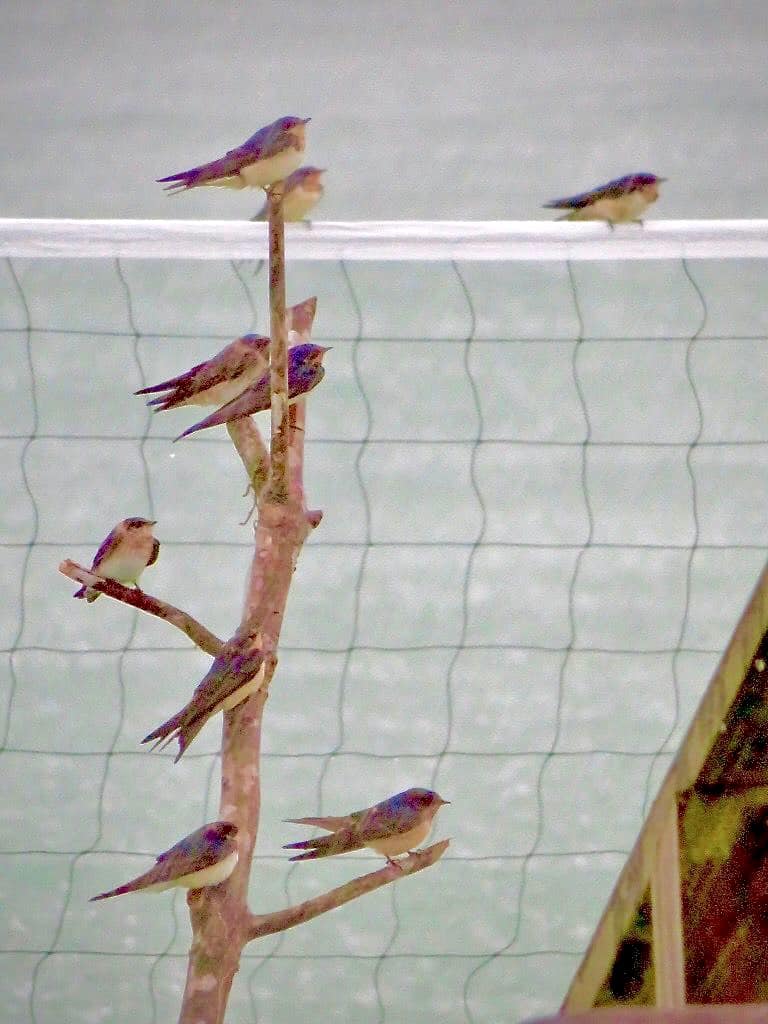
These barn swallows halted their flight when a storm blew in, and they’ll stop wherever they can find a descent, safe perch..these were enjoying Casa Cayuco’s water volleyball court as a safe stopover to rest and prepare to carry on as soon as the storm passes. In fact, when I’ve been paddle boarding, I’ve come across more than one hundred swallows perched on an abandoned sailboat, the entire railing full of preening swallows.
These birds nest in North America, nearly to the top of Canada and as they shift south, it’s as if these birds are constantly in migration, south for the winter all the way to Patagonia and you hardly see the last south-headed bird before you see them start to head north again (these individuals likely being Canada-bound birds that wintered in lower South America. And early spring, they start moving northward to our temperate continent that is rich with juicy little insects for the birds to take on the energy-intensive breeding season, our temperate zone summer.
Once their babies fledge (fly out of the nest for the first time) they get the news: we’re flying south and it’s a LONG way away. In the wintertime here in our tropical latitudes they are able to feed all winter and build up enough energy to fly north again for yet another year.
People often ask, why would a bird leave the tropics when there’s SO MUCH FOOD all year, well the biodiversity of the tropics include a lot of predators, including nest predators (think snakes, ants, arboreal mammals, so the birds opt to leave the tropics each summer to where they can spread out across the continent, establish their territory and raise babies in a more secure environment.
Migratory birds are some of our most threatened species considering their long hard travels twice yearly. Many birds die along the way for lack of “stopover” sites where the birds rest and refuel. They rely on undisturbed habitat to feed and in the epoch of detrimental human impact, we’re losing habitat as I write this.
The population of these birds is a reflection of habitat loss and we’re learning more and more about how the different species of migratory birds is impacted.
What can we do? Plant fruiting and flowering bushes and trees! If you have an empty lawn, better to adorn it with fruits and flowers to attract wildlife and both migratory and residential birds. The melastomatacea (Miconia) is a family of trees and bushes that are prolific in their fruiting and will fruit multiple times a year, fairly well matching up when our northern migrants pass through, needing to fill their bellies as fast as possible as they’re low on fuel, those birds crossing the Caribbean after funneling down through florida. They’re desperate to feed and sometimes they’ll practically fall before your feet, grabbing any insect or berry they can find, desperate to fill their empty bellies.
Other possibilities for wildlife (especially pollinator) friendly plants and trees are verbena (porterweed), tropical milkweed, any and all Melastomas, fig trees, ginger plants, heliconias, French kiss ginger, coral trees and mataraton living-fence trees, firecracker plant and more!
Keep an eye out for barn swallow flying just above the water as it matches your boat’s speed. They are mainly moving in the morning but most in the afternoon til near dark if they have trouble finding a safe place to sleep.
Leave a Reply